


Note
•
EBS (Elastic Block Store) is a network drive
◦
Can only attach one instance at a time
•
Can make snapshots for backup and multi AZ/Region deployment
•
4 types of EBS Volumes: here
•
EBS multi-attach for io1/io2 family
◦
Provides high application availability in clustered Linux applications
◦
Up to 16 EC2 Instances at a time
EBS Volume
•
An Elastic Block Store (EBS) Volume is a network drive you can attach to your instances while they run
•
It allows your instances to persist data, even after their termination
•
They can only be mounted to one instance at a time (at the CCP level)
•
They are bound to a specific availability zone
•
Analogy: Think of them as a “network USB stick”
•
It’s a network drive
◦
It uses the network to communicate the instance, which means there might be a bit of latency
◦
It can be detached from an EC2 instance and attached to another one quickly
•
It’s locked to an Availability Zone (AZ)
◦
Can work around using snapshots
•
Have a provisioned capacity
◦
You get billed for all the provisioned capacity
◦
You can increase the capacity of the drive over time
Delete on Termination
•
Controls the EBS behaviour when an EC2 instance terminates
•
By default, the root EBS is deleted (attribute enabled)
•
By default, the other attached EBS volume is not deleted (attribute disabled)
•
Can be controlled by the AWS console / AWS CLI
•
Use Case: preserve root volume when instance is terminated
EBS Snapshots
•
Make a backup (snapshot) of your EBS volume at a point in time
•
Not necessary to detach volume to do snapshot, but recommended
•
Can copy snapshots across AZ or Region
EBS Snapshots Features
•
EBS Snapshot Archive
◦
Move a Snapshot to an “archive tier” that is 75% cheaper
◦
Takes within 24 to 72 hours for restoring the archive
•
Recycle Bin for EBS Snapshots
◦
Setup rules to retain deleted snapshots so you can recover them after an accidental deletion
◦
Specify retention (from 1 day to 1 year)
•
Fast Snapshot Restore (FSR)
◦
Force full initialization of snapshot to have no latency on the first use ($$$)
EBS Volume Types
•
EBS Volume come in 6 types
◦
gp2 / gp3 (SSD): General purpose SSD volume that balances price and performance for a wide variety of workloads
◦
io1 / io2 (SSD): Highest-performance SSD volume for mission-critical low-latency or high-throughput workloads
◦
st1 (HDD): Low cost HDD volume designed for frequently accessed, throughput-intensive workloads
◦
sc1 (HDD): Lowest cost HDD volume designed for less frequently accessed workloads
•
Only gp2/gp3 and io1/io2 can be used as boot volumes
General Purpose SSD
•
cost effective storage, low-latency
•
System boot volumes, Virtual desktops, Development and test environments
Provisioned IOPS (PIOPS) SSD
•
Critical business applications with sustained IOPS performance
•
Or applications that need more than 16,000 IOPS
•
Great for database workloads (sensitive to storage perf and consistency)
•
Supports EBS Multi-attach
Hard Disk Drives (HDD)
•
Cannot be a boot volume
•
Throughput Optimized HDD
◦
Big Data, Data Warehouses, Log Processing
•
Cold HDD:
◦
For data that is infrequently accessed
◦
Scenarios where lowest cost is important
EBS Multi-Attach - io1/io2 family
•
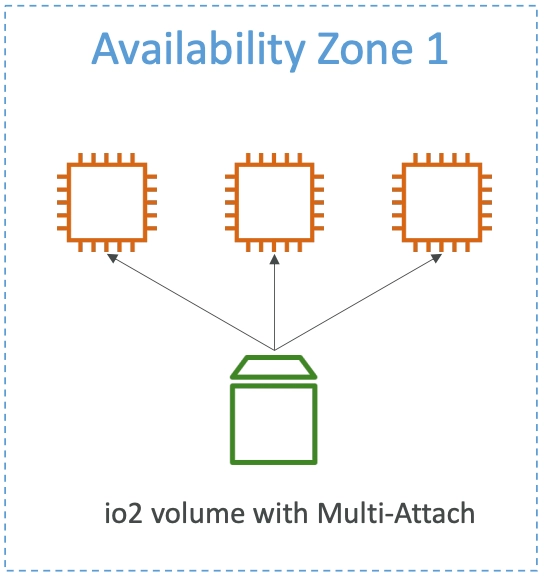
Attach the same EBS volume to multiple EC2 instances in the same AZ
•
Each instance has full read & write permissions to the high-performance volume
•
Use case:
◦
Achieve higher application availability in clustered Linux applications
◦
Applications must manage concurrent write operations
•
Up to 16 EC2 Instances at a time
•
Must use a file system that’s cluster-aware (not XFS, EX4, etc…)